Sunday, March 17, 2013

Medieval Market Then and Now!


There is an interesting town in England called Norwich. It was once a Saxon town and a thriving trade center. It became a Norman town under William the Conqueror and he founded a castle there between 1066 and 1075. Interestingly, the market still exists in Norwich today, and there are over 190 stalls with people selling all sorts of things from food to clothing and more! Here is a link to an interactive map of what the market place looked like in the year 1300 and what sorts of things people were selling: http://www.norwich-market.org.uk/Medieval/wares.shtm . Roll your cursor over the pictures bordering the map for more information! Here is a link to what the market looks like today: market.org.uk/stalls/stalls_videos_WMV/stalls_WMV.shtm  Roll your cursor over the numbers on the booths for information about what is being sold there today!

Thursday, March 7, 2013

Medieval Guilds and Trade Fairs

The Crusades focused people's attention on religion, but they ended up having a powerful impact on Medieval Life in another way. They helped introduce people in Europe to new products from other countries, like spices, scented soaps, colorful rugs, and more. As people wanted to have these and other products, new trade routes opened and people from many countries began transporting their goods by land and by sea. Along some of the main routes, trade fairs were set up so merchants could sell their goods. Go to this web site and read more: http://medievaleurope.mrdonn.org/tradefairs.html.


Thursday, February 28, 2013

Medieval Guilds


Knights and nobles weren't the only ones who used coats-of-arms. Medieval Guilds would often display a coat-of-arms in their guild hall. A guild was a group of skilled craftsmen who did the same job. So, a group of shoemakers living in the same town would have formed a guild to make sure shoes were made to a certain standard of quality, to make sure that they sold for a fair price, and to make sure that their members had specific skills. To become a guildsman, a person had to go through three steps: apprentice, journeyman, and finally, a master. The two shields above represent the blacksmith guild and the shoemaker guild.


Tuesday, February 19, 2013

Heraldry in American History.


The Arms of George Washington, 1st President of the United States. His shield appears on the Purple Heart as seen below. The original Purple Heart was established by George Washington as a Badge of Military Merit when he was Commander-in-chief of the Continental Army, 1782. Today it is a United States military decoration awarded by the President to those who have been wounded or killed while in service since April 5, 1917.


Modern Day Heraldic Artist works magic!

The art of heraldry is practiced today. Andrew Stewart Jamieson creates magnificent coats-of-arms. See the video below.

Thursday, February 14, 2013

Heralds record Coats-of-Arms in books called Rolls of Arms


Coats of Arms are more than just interesting colorful symbols placed on "awesome" shields. A Coat of Arms tells us about people and families that lived hundreds of years ago. In the middle ages it was a herald's job to know which coat of arms belonged to which knight or nobleman. Heralds often kept a record of coats of arms by drawing or painting them on a roll of parchment. It sometimes stayed in the form of a roll and other times it was made into a book. This record-keeping format became known as a Roll of Arms and it generally included rows of painted shields along with the name of the person who owned the coat of arms. Roll of Arms are important primary documents that preserve information about many generations of knights and families dating back to the 1200s and are still being made by 21st century heralds today.
The above picture is of a page from the Hyghalmen Roll, Germany, dating back to 1485.


Thursday, February 7, 2013

The Science of Heraldry

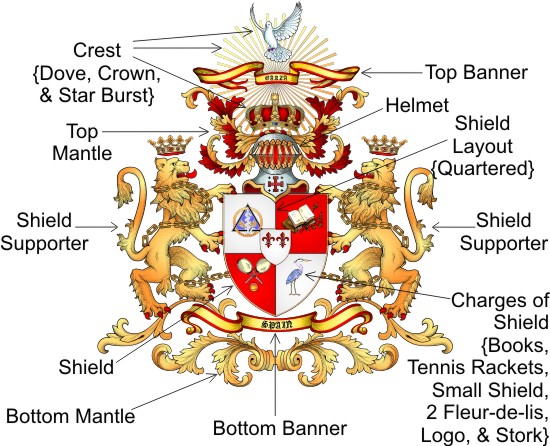
Heraldry, a system of using a variety of shapes and symbols on a shield or coat of arms to identify an individual or family, is almost 900 years old. The use of symbols on shields can be seen in the Bayeux Tapestry, a tapestry which we studied earlier this year and which is thought to have been made in the 1070's. It became a herald's job to create and keep records of the symbols and coats of arms. Go to the web site for the International Heraldry & Heralds to learn more and see amazing images:

http://www.internationalheraldry.com/

Below is a full achievement of arms


To play a heraldry game requiring skill,  Click Here! To create a shield online, Click Here!


Friday, February 1, 2013

Enjoy Our Illuminated Manuscripts!


Medieval Research and Manuscript Assignment

Ye shall research your assigned topic: Book of Hours.

Your final product will consist of the following:


An illuminated manuscript written in calligraphy on parchment. 
It should include the following:


  • An illuminated letter
  • A rubric…in Latin using calligraphy printing
  • A historiated letter
  • An inhabited margin
  • A miniature painting 
  • Text: should be a prayer, poem, etc. that you might recite at one of the eight times for prayer in your short version of a Book of Hours.                                                                     


Thursday, January 24, 2013

A 21st Century Illuminator creates a 21st Century Illuminated Manuscript!

Calligraphers and illumination artists were jobs in the middle ages. However, they are also jobs in the 21st century! In 1998 a group of people at St. John's Abby and University met with master calligrapher Donald Jackson to start a project to create the first handwritten bible since the invention of the printing press! The bible is called The St. John's Bible. It is seven volumes, each 2 feet tall, and 3 feet wide when opened! It is made of vellum, has about 160 illuminations, and cost about $8 million dollars to produce!


To learn a little more about this modern day illuminated manuscript, go to this web page and click on Layout & Design and Tools and Materials. 

Click Here!

Young historians just like you study the art of illuminating letters! Below is a video of illuminated letter artwork created by elementary students.


Thursday, January 17, 2013

What is the Book of Kells?


There are some wonderful illuminated manuscripts that have survived the test of time! Click Here!

Thursday, January 10, 2013

Monks preserve history in illuminated manuscripts.

As you listen to the lyrics of the song sung on this video, you will hear a variety of the materials used to make the illuminations. Enjoy!


There were many steps necessary to make an illuminated manuscript, and a number of people were involved in the process. Go to this web site to find out more. Click Here!!!

Thursday, December 13, 2012

A Squire has much to learn before becoming a knight!

When a knight practiced, prepared for battle, or went to compete in a tournament, his squire would go with him. Can you tell what some of his duties might be after watching these two videos?


Thursday, December 6, 2012

The Life of a Medieval Knight

Three groups of fighting men were important in the middle ages: foot soldiers, archers, and knights. The knight who visited us on the first day of school this year, Sir Karl Kindt, gave us an introduction to what it meant to be a knight in the middle ages. It is time to learn more about knights, so check out these web sites:
The Medieval Knight:
http://library.thinkquest.org/10949/fief/medknight.html#become

Sir Karl Kindt, Knight for Hire:
http://www.knightforhire.com/


Illustration of a knight (ca. 1250 C.E.) thought by some to represent 
King Henry III of England...image on this web site: http://www.knightsandarmor.com/ 

Thursday, November 29, 2012

King Edward I and his castles in Wales


As history detectives, it is only natural that we would be curious about how people, places and things actually looked in long ago. For times before photography, we must rely on sketches, paintings, and other forms of artwork produced during the period we are studying. Below are two images of King Edward I, the English king who invaded Wales and strengthened his powerful hold over the country by building incredible castles and walled towns. Here are two images of Edward. The first is from a medieval manuscript created in the early 1300's, and the image is of King Edward and his queen,Eleanor of Castile. The second picture is a genealogy of Kings of Britain starting with Edward the Confessor and ending with a small picture of King Edward I. This is actually a page from a medieval manuscript produced in the 1200's. 


Above image of King Edward and Queen Eleanor of Castile from Wikipedia. The image below is from the Bodelian Library at the University of Oxford, displayed on the LUNA web site.


Here is a map of the castles King Edward I built in Wales. Go to this web site and find information about why Edward built these castles along the coast (hint: read the second paragraph):

 http://www.timeref.com/castedwd.htm

Map of castles built by Edward I


Thursday, November 15, 2012

Castles Under Attack simulation!


Throughout the middle ages castle construction evolved from Motte and Baily castles made of wood to Stone Keep castles made of stone to Concentric castles which utilized thick/tall stone walls built around the stone keep. Castle builders had to come up with new materials to use, new building techniques, new types of castles, and new castle features to withstand attacks by armies that were constantly developing new methods of attack and new weapons to use against castles. Go to this web site and play the Castle Under Attack simulation game! Click here: http://www.historyonthenet.com/Lessons/attackdefendcastle/mottebailey.htm


Parts of a castle: crenellations, merlons, and arrowloops.

Castle walls were built with defense in mind. Below are pictures showing crenellations and merlons along the top wall of a castle. Note the different shapes of arrowloops. Here is a link to a web site with information about crenellations: http://www.castles.me.uk/crenellations.htm


Arrowloops were typically wider on the inside of the wall and narrower on the outside. 


Internal view of arrowloop.


External View of arrowloops.                     

Wednesday, October 31, 2012

Parts of a Castle: The Gatehouse

This is a picture from inside the gatehouse in Leeds Castle, Kent, England.


This is a Norman castle gatehouse in Carmarthen, South West Wales. It dates to about 1409.


Wednesday, October 24, 2012

Castles: Medieval War Machines!


This is a picture of Harlech Castle in Wales. 

It was built by King Edward I between 1282 and 1289. Image from Wikipedia

Here is the historical scenario for our castle mapping and building project:


The year is 1282. King Edward I of England has defeated the last Welsch governing family, Prince Llywelyn ap Gruffydd and his brother Dafydd...their last rebellion leading to their eventual defeat and death. King Edward now plans to annex all of Wales and build castles throughout the country to protect his new land. English soldiers will be garrisoned in the castles, and the towns will be settled by English colonists. King Edward's head architect, Master James St. George, has given you the responsibility of planning and building a castle for King Edward. This castle is to be located on Cardigan Bay on the west side of Wales. Where will you choose to build your castle, and why there? Be prepared to defend your overall building plan.


Here is the link to the web site where you can watch

the last three parts of the castle video we watched this week: 

 http://thehelpfulartteacher.blogspot.com/2012/02/medieval-castles.html


Thursday, October 18, 2012

Can a quilt made in the 21st century be a primary source?

Here is an interview with the artist of the quilt called Blue Men. Read it carefully. Then think about whether this quilt is a primary source that tells us about a tribe of people called the Tuaregs.


Interview for Quilt Alliance Nov 11, 2001JoAnn Popisil  interviewing artist Hollis Chatelain       
http://www.allianceforamericanquilts.org/qsos/interview.php?kid=14-31-363“JP: Who inspired you, as far as this quilt? The friends that you talked about. “HC: It especially started when I lived in Burkina Faso. There are a lot of Tuaregs. The Tuaregs are a tribe that is nomadic. They cross the desert on their camels, on their caravans, and they traditionally carry the goods from north Africa to black Africa. They're really wonderful people. I was very intrigued by them. The men wear indigo blue turbans to protect themselves from the sun and the sand. The indigo, the blue, actually tints their skin blue. That's why this is called "Blue Men" and why it's painted in blue dyes. When I lived in Burkina Faso these Tuaregs used to come to the house. These are Tuareg earrings that I'm wearing right now. They make leather boxes, and silver jewelry. I learned a lot from those people. Once they realize that you'll buy things, then they're there all the time, and they want you to sell their handicrafts for them, because they figure you know more people that have money. I've spent thousands of hours with these people. I learned to drink Tuareg tea with them, and they have a wonderful sense of humor. Everywhere that I lived in the Sahel region, which is the sub-Saharan area in West Africa, there were Tuaregs. I became friends with them. Never the women, always the men. The Tuaregs would come into the city to sell their handicrafts. I became good friends with them, and this is a tribute to those people.


Friday, October 12, 2012

The Bayeux Tapestry & the The Battle of Hastings

October 14, 1066 is know as a pivotal year in medieval history as an English King dies and leaves a power vacuum that draws in three powerful claimants: a Viking from Norway, a French Norman, and and English Saxon. When English King Edward dies, Englishman Harold Godwinson is endorsed by the Witan, a royal council of advisors, to become the next King. Frenchman William, Duke of Normandy, says the throne was promised to him by the former King Edward, and starts to pull an army together to fight for the crown. At the same time, Viking King Harald Hardrada of Norway says the crown belongs to him, and he also gathers an army. Hardrada and his army invade England in the north, and King Harold goes to fight him in a battle at Stamford Bridge. Hardrada is badly defeated. Meanwhile, William of Normandy lands his army in the south of England, and King Harold now travels to meet William to do battle at Hastings. The video below covers this part of the battle. It focuses on battle strategy, weapons, and how the battle ends.


                                      Below: Norman Soldiers on horseback in the Bayeux Tapestry

Historians consider the Bayeux Tapestry a primary source of information about the Battle of Hastings. This artifact is 230 feet long and 20 inches high. How has such an unusual source survived over 900+ years?! Today it is kept in a museum, the Tapisserie de Bayeux in Bayeux, France. Here is a link to the museum that will give you information about how such a rare source is cared for today:
http://www.tapestry-bayeux.com/index.php?id=403


Thursday, October 4, 2012

The Feudalism Thing?!!!


Here is a fun way to review Feudalism and life on a 

Medieval Manor! Click on the video below.


Below is your first online participation assignment! Type your name, first and last, in the Name box. Then read the question and type your answer in the box below the question. Finally, click Submit. That's all there is to it! 


Thursday, September 27, 2012

Explore Medieval Manors with SketchUp


SketchUp is a 3-D technology tool. It is a tool that can help people investigate something from multiple angles. It allows you to explore something both inside as well as outside, to see the structure of something from the inside. It can help make a complex topic easier to understand. So, take a few minutes to explore how other people are using SketchUp to experience a medieval manor!


 Also, go to this link to see more SketchUp mpodels of medieval manors:
http://sketchup.google.com/3dwarehouse/search?q=medieval+manors&styp=m&scoring=t&btnG=Search

Friday, September 21, 2012

Medieval Manor House description


A noble who swore an oath of loyalty to his King was often given some land to live on. The property was called a manor, and the lord would live in a manor house on the land and oversee the farming and productivity of this property. The main feature of a manor house was its great hall. The Lord of the Manor would hold legal trials or sessions of his manor court in the great hall. The manor house was not typically built with strong fortifications like a castle, but many did have walls or ditches enclosing the house and farm buildings for protection against robbers and thieves. Some even had moats with drawbridges, gatehouses and watchtowers.


“This description of a manor house at Chingford, Essex in England was recorded in a document for the Chapter of St Paul's Cathedral when it was granted to Robert Le Moyne in 1265: 


He received also a sufficient and handsome hall well ceiled with oak. On the western side is a worthy bed, on the ground, a stone chimney, a wardrobe and a certain other small chamber; at the eastern end is a pantry and a buttery. Between the hall and the chapel is a sideroom. There is a decent chapel covered with tiles, a portable altar, and a small cross. In the hall are four tables on trestles. There are likewise a good kitchen covered with tiles, with a furnace and ovens, one large, the other small, for cakes, two tables, and alongside the kitchen a small house for baking. Also a new granary covered with oak shingles, and a building in which the dairy is contained, though it is divided. Likewise a chamber suited for clergymen and a necessary chamber. Also a hen-house. These are within the inner gate. Likewise outside of that gate are an old house for the servants, a good table, long and divided, and to the east of the principal building, beyond the smaller stable, a solar for the use of the servants. Also a building in which is contained a bed, also two barns, one for wheat and one for oats. These buildings are enclosed with a moat, a wall, and a hedge. Also beyond the middle gate is a good barn, and a stable of cows, and another for oxen, these old and ruinous. Also beyond the outer gate is a pigstye.”

Source: http://www.castlesandmanorhouses.com/


Posted by Picasa

Tuesday, September 18, 2012

Medieval Manor


"Manorial Court Records are one of the few items of documentary evidence which have helped historians understand more about this way of life. The most important lords held regular courts at their manors as a way of ensuring and administering justice. Each manor had its own laws, which varied depending upon area and local custom. The proceedings of each court were recorded on manor rolls, some of which still survive today to give historians an idea of justice in the Middle Ages."
Quote from Medieval History @ suite 101